 Tom Ives
Matter Over Mind
Posted on November 13, 2019 1 Comment
Every day I can, I get up before my family, have a shot of coffee and jump on an exercise bike. I ride as fast as i can, with as much resistance as i can, for 15 minutes.
I wear a heart rate monitor linked to my phone. I listen to a Spotify playlist full of repetitive, high energy bangers to get me going.
In the first five minutes my body wakes up, then warms up, and settles into a hard rhythm that pushes my heart beats per minute above 170 – my personal stress level for cardio.
By 15 minutes I’m really hot and sweaty, my legs are burning and the pace has become difficult to keep up. I jump off, eat breakfast with my two daughters, get showered up and start the day feeling ready for whatever may come.
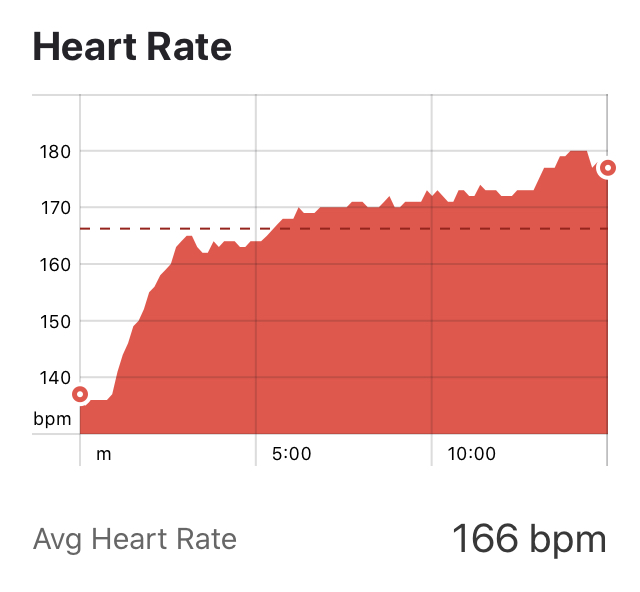
Riding a static ‘turbo trainer’ bike is beyond dull – nothing like riding outdoors. The bit I enjoy is the intensity of the exercise. You take everything but cardio training out of the ride. In 15 minutes you can see what state your body is in, how ‘on it’ you are that day. A good effort on the turbo equates to ten minutes at my peak heart rate. Ten minutes of peak is often twice what I manage on a two hour road ride or an all day mountain trail ride.
I started to force fitness into my daily routine and get some oomph at the start of stressful days in the office. It was a real bonus to find the discipline helped my mental fitness too.
When I am down, or I’m processing a difficult issue in my life, I over think and analyse all the possible outcomes, good and bad of virtually all I have done and could do. This side of me has brought success in my career, but in the last two years I’ve learned it can be a weakness too.
When I jump on the bike these thoughts remain, whirling around my mind with nothing to distract me from them. It feels like they circle around my head – big, noisy concepts and possibilities. Some are waves of emotion and others logical puzzle boxes I can’t close or put down.
As I warm up I notice things change.
My body comes to the rescue.
Nervous leg muscles release like springs to drive me somewhere. My knees circle like a clockwork machine shifted from idle to first gear. My body warms up in a wave starting from my toes. Ten minutes into the ride the heat reaches my heart, now in top gear to push me up an imaginary hill while my lungs force cold air into the system.
It simply feels there is no place in my forearms or hamstrings for anxiety about work. Worries about the future can’t remain in a chest full of joyful, thoughtless effort.
The tunes play their part too. Tempo is important – a good match with my cadence is perfect to latch onto. Lyrics and melody gave my mind something useful to do – the focus giving me enthusiasm and motivation to rev the engine and drive my legs harder at a drop or climax.
I found the most effective songs are punk – reminding me I still love rock music. I was a hard rocker in my teenage years, and moved into similarly high energy and aggressive dance music in my tweens. This changed slowly to mix in mellow music like Portishead, Massive Attack, Burial and The XX. In my thirties I have shifted further into folk, jazz, classical and minimal electronica. I find epic jams in a minor key comforting, especially when I need to focus on work.
But on the bike punk music reminded me that anger is an energy. I like raspy blunt music that doesn’t give a f*ck. Life is full of injustice but rather than cry about it, shout and rage. I vent my frustration into the pedals.
The elation of exertion comes as the heat hits my head, sweat literally rising as steam, my inner critic’s voice drowned out by millions of cells pulsing with positive, vital energy.
If I chose to, I can bring my ponderings back and see them beyond my body for what they are; a challenge that my body and I can deal with. Like attacking a mountain road or flowing single track.
The mind can push the body beyond reason.
I have learned that the body can push the mind back into it’s box
Matter over mind.
Going freelance
Posted on June 12, 2019 Leave a Comment
So many of my friends and colleagues have made it work, it’s very common in the marketing industry. I’ve been employed for so long – it feels natural and secure to be part of team. But the trade off is a necessary ‘towing of the line’ – fitting in rather than trying it your own way. I do get frustrated when I know this a better way to do things. I now have the experience and contacts to walk the talk!
I’ve had three great projects so far. I’ve loved supporting rbl as a freelance account director, delivering research for rebranding projects. I also have two clients of my own.
Bikmo and British Cycling
Bikmo is a specialist cycle insurance provider. I’ve been a customers for years and had great service when my mountain bike was damaged in a crash. I believe they have a real CX advantage over general insurers because they are all mad about bikes.
Bikmo secured a big deal in 2019 – becoming the insurance provider to British Cycling. Becoming a member of British Cycling means cover for personal injury and liability – something less obvious than protection for the bike itself. This is the kind of education British Cycling is responsible for, along with officiating all serious races in the UK.
I’d visited a British Cycling event with my family when the national cross country event came to our local trails – Cannock Chase. I was impressed with the set up and racers – but even more so by the support of families to watch the races from under 14 to over 60s. It’s a sport with better gender equality than most – plenty of role models for my daughters in all cycling disciplines.
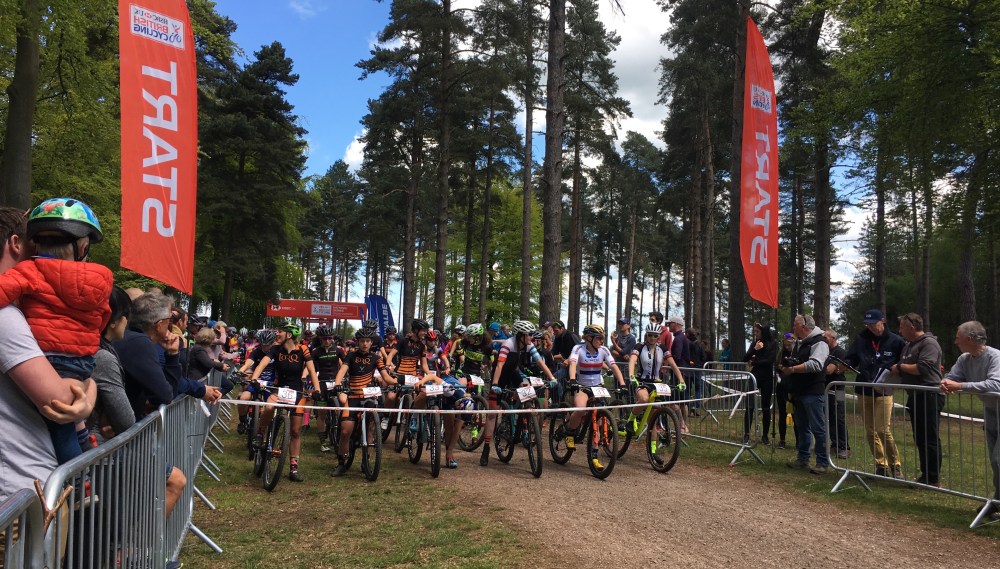
I worked with Bikmo to help them make the most of the brand partnership with British Cycling. A new website, video and various member communications needed a co-branded identity. I used my own experience and plenty of research to explore the proposition to members and their reasons to buy or not buy insurance from Bikmo. I proposed this rationale along with messaging and visual treatment for the partnership. The proposed solution went live in May.
Earthworm
Earthworm is an ethical investment start-up, providing sustainable returns for people who may have never invested their savings before. I was contracted to conduct a UX review of their current website and digital strategy. I studied their objectives, performance data, site and content, in order to recommend improvements. Once the rationale was agreed, I suggested new UX for the entire site, focused around distinct user journeys. Using Balsamiq I wireframed new pages starting at mobile screen size to get the priority and brevity right. Then I worked up from mobile to tablet and desktop, finishing with a designed mockup with suggested content. The changes will be applied later in 2019.
Brands and Branding
Posted on June 12, 2019 1 Comment
In January I started working at the small but mighty branding agency rbl in Leamington. I didn’t know them as well as other Midlands agencies and I was amazed at their creds when I met them. Their work on the London 2012 Olympics is stunning and when their branding of the Birmingham 2022 Commonwealth games is launched it’s going to really stand out. If you are a Leamington local and ever wondered why Coffee Architects has become a phenomenon, they did their branding too.

The agency is led by Rebecca Battman – a super experienced branding professional and big personality in the Warwickshire community. She’s created a truly unique set up in rbl – something every agency claims but are ultimately similar in most ways.
I worked on several long re-branding projects for new clients along with week by week production of existing ones.
I conducted research within the world of building engineering – something all around us but largely invisible when it’s done correctly. The Grenfell disaster has brought the discipline into the public eye in a powerful way – something the whole industry is reacting to.
I was also responsible for brand research of a safety equipment manufacturer. This involved employee workshops, telephone interviews with customers and an online survey to gather dozens of different points of view on what the company was best known for – and how this could change. I learn’t a huge amount about the world of B2B marketing and the challenges of a truly ethical supply chain. There are some truly amazing personal protective equipment (PPE) products on the market – my DIY will certainly benefit from what I have learnt.
The team at rbl is truly multi disciplinary with very high standards for everything from environment design to web builds. I’ve learnt a huge amount from them in a short time which is already helping me in my freelance work.
UK MTB Tour
Posted on June 30, 2018
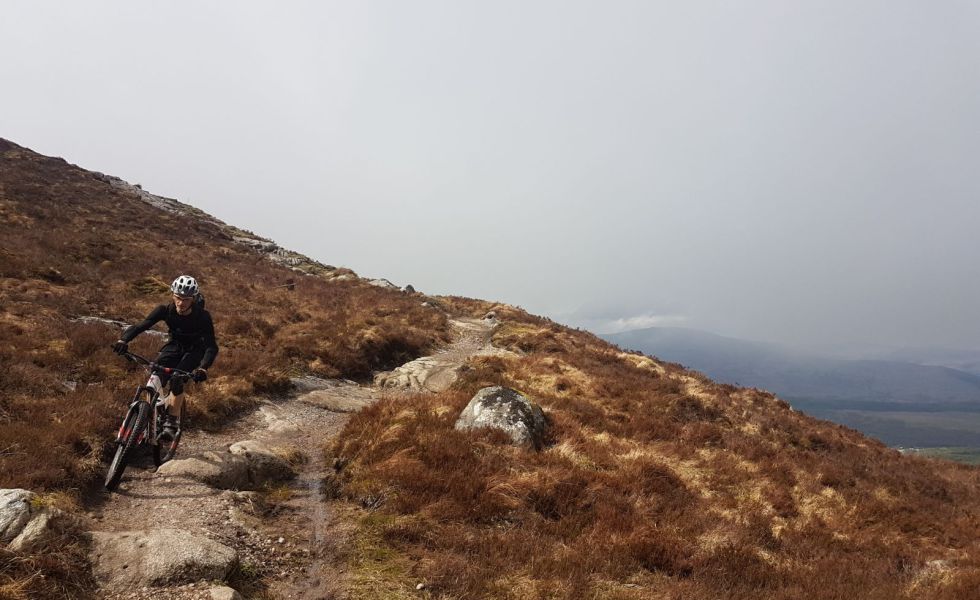
In early May 2018 I went on a very special holiday with two good friends. We had a long ‘lads only’ weekend touring the wilder bits of England and Scotland to ride stunning trail centres on our mountain bikes. Weather and vibes were awesome, and the riding was unreal. This is the story of our UK MTB Tour.

My brother kindly lent me his spare bike as my cross country mountain bike needed repairing, and wasn’t best suited to the mountainous down hill riding we were going to encounter in Scotland. The bike was a few years old but had a few gadgets that were new to me – a dropper post to get the saddle out of the way when going downhill fast, and longer travel suspension for absorbing the hits of bumpy rocky terrain. It felt awesome – I was ready to test it out!
Thursday
Packing and prep was an epic faff – I was up till 1am.
Friday
I had a 5am start to leave Warwick and get to my pal Jim’s house in Birmingham for a 7.30 departure. We were joined by two others – bike shredder Maruisz and Bach the white sheep dog. We were travelling in style in Jim’s huge camper van – complete with shower, garage for bikes and plenty of room for food and gear.
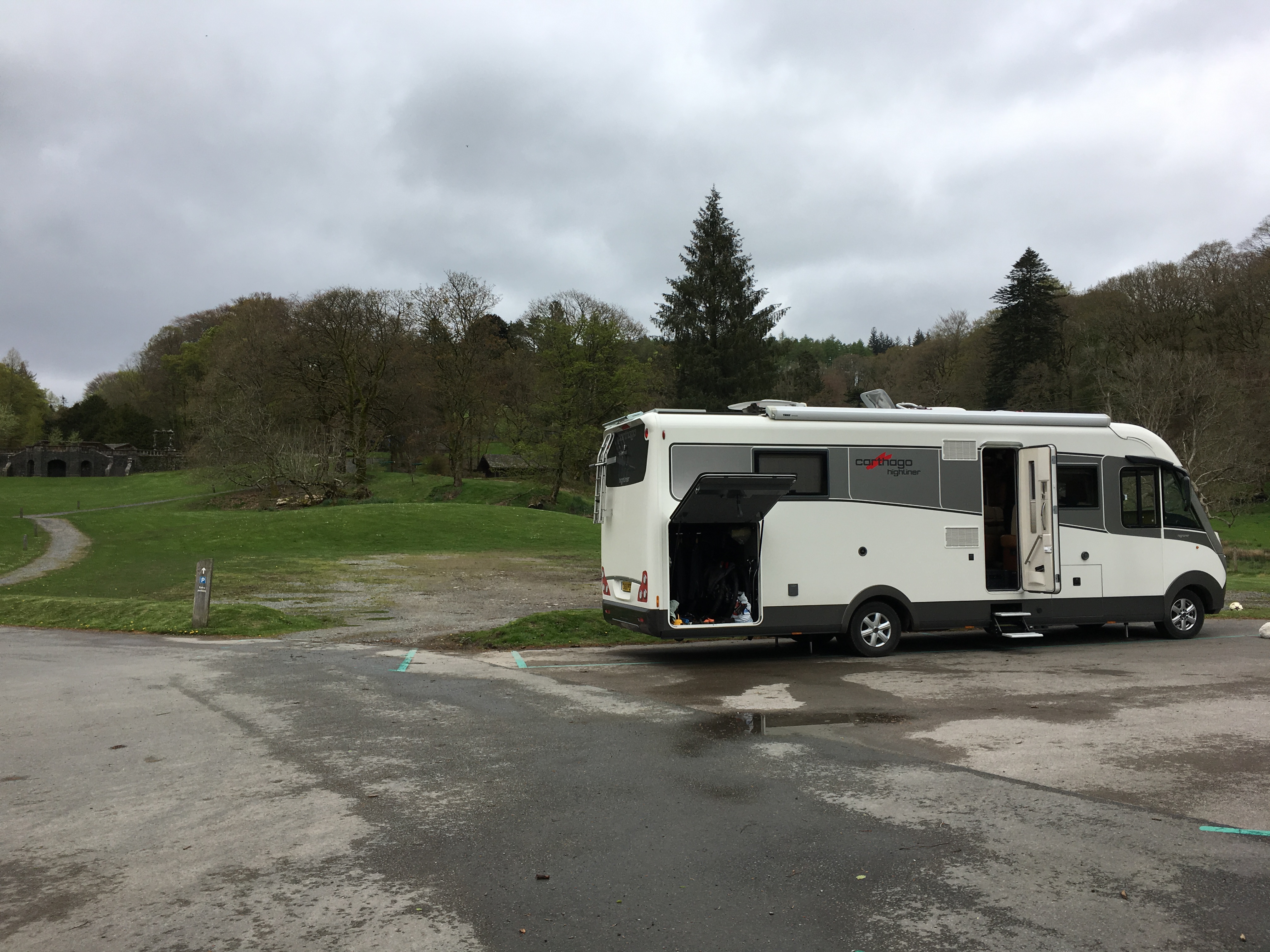
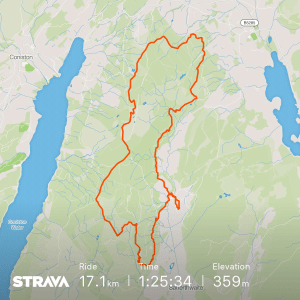
We hit our first stop on the tour at 11am – Grizedale Forest trail centre in the Lake District. We were hyper after hours in van and with the sun shining we jumped on our bikes and hit the trail.
We rode short but tricky trails with technical climbs and descents plus stunning views of Coniston water in the sunshine.
However my terrible mechanic skills meant the trek crank thread had been stripped by putting the pedals in and became loose. The day (and trip) was saved by the super friendly Grizedale bike shop who had a (now rare) Shimano three ring crank set I could afford. Mariusz worked in a bike shop for many years so fitted it in 5 minutes (and taught me how to pedals in correctly – I will never make that mistake again!)
We decided to shoot up the M6 to Scotland while we could get ahead of the bank holiday traffic. We drove through stunning weather and views of Ambleside, Windermere and Kendal.
Hitting the Scottish border at Gretna Green the temperature dropped to 11 degrees and we headed west to the Forest of Ae. We arrived in mist and drizzle, joking we had left the sunniest day in the lakes for this.
We had a few snacks and hit the trails again.
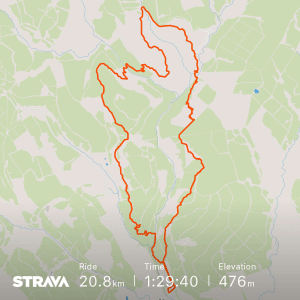
The Forest of Ae had a great loop with steep trails (up and down) and beautiful woods with sculptures and windmills looming out of the mist.

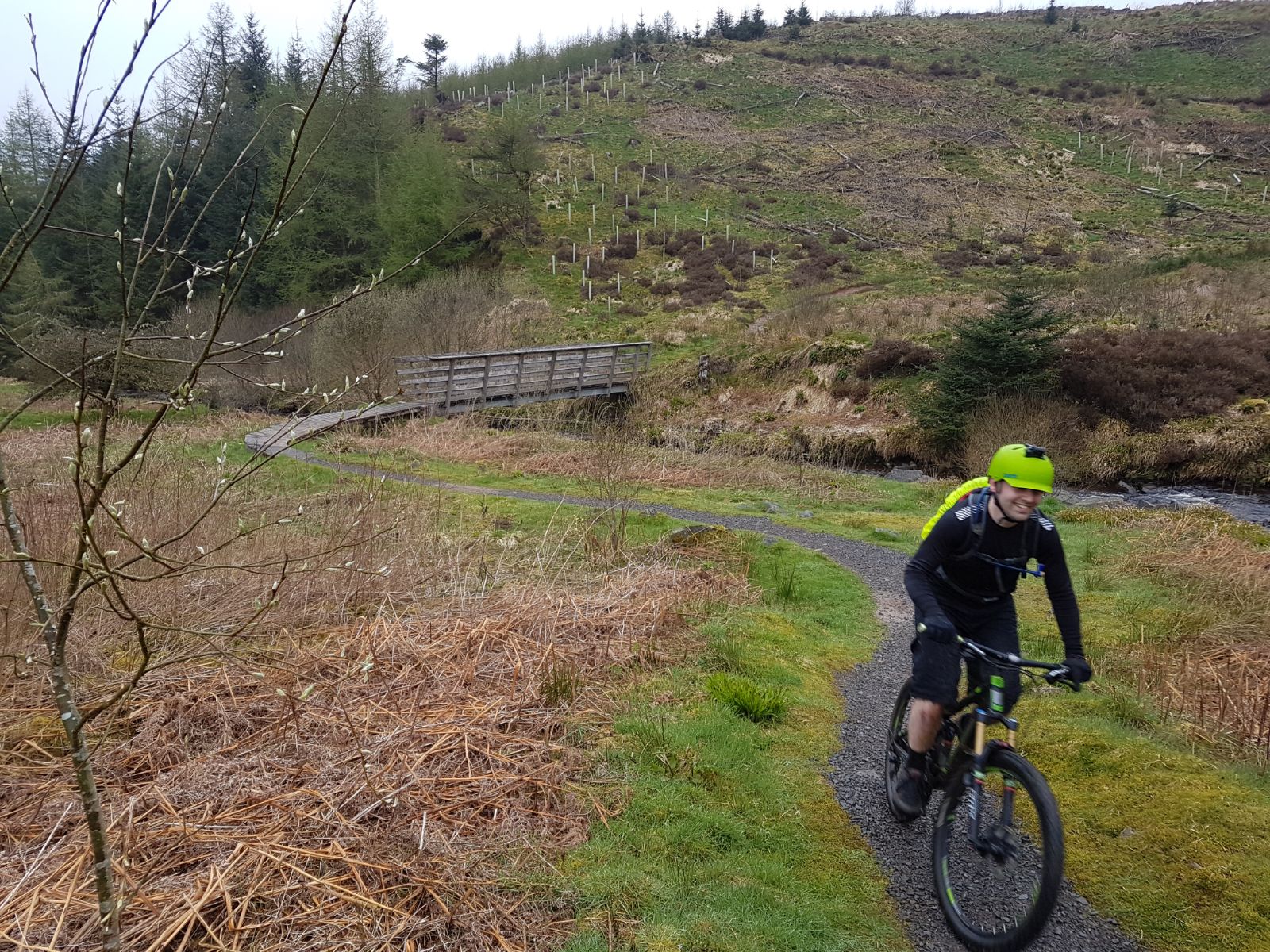
The final kilometre was a downhill track with beginners areas to build up confidence.
We got back to the campervan for half seven and got cleaned up.
There was much giggling from our van
There were other touring bikers in vans – including some Germans who got naked and used the bike wash tap and hose to have a wash. We had an excellent vegan dinner prepared by Jim’s amazing wife Jo, and enjoyed some zero alcohol beers (!?) while using the van’s satelitte dish to watch TV – bizzarely Michael Portillo exploring the history of UK prisons.
Friday
In the morning we couldn’t start the van due the two batteries getting confused and draining each other. Thanks to a jumpstart we got it going but then we couldn’t put the van in gear as the automatic gearbox and other electric systems was confused. I’ve concluded on this trip that campervans are as much a hobby as a possession because you need to know how to fix every part of both a house and lorry while on a layby in the middle of nowhere. We feared the trip was going to end on the back of a recovery lorry, but as a last gasp option Mariusz suggested turning everything off (unplugging batteries) to reset it. Amazingly it worked! Every system then needed configuring again from the reset – starting with Satnav to get us back on the road.
We travelled North to the beautiful Loch Lomond, where we had an ambitious plan to hike up to the top of Ben Lomond and ride back down. We got on the trail at 3pm and pushed or carried our bikes for three hours until we hit the snow line at 800 metres.
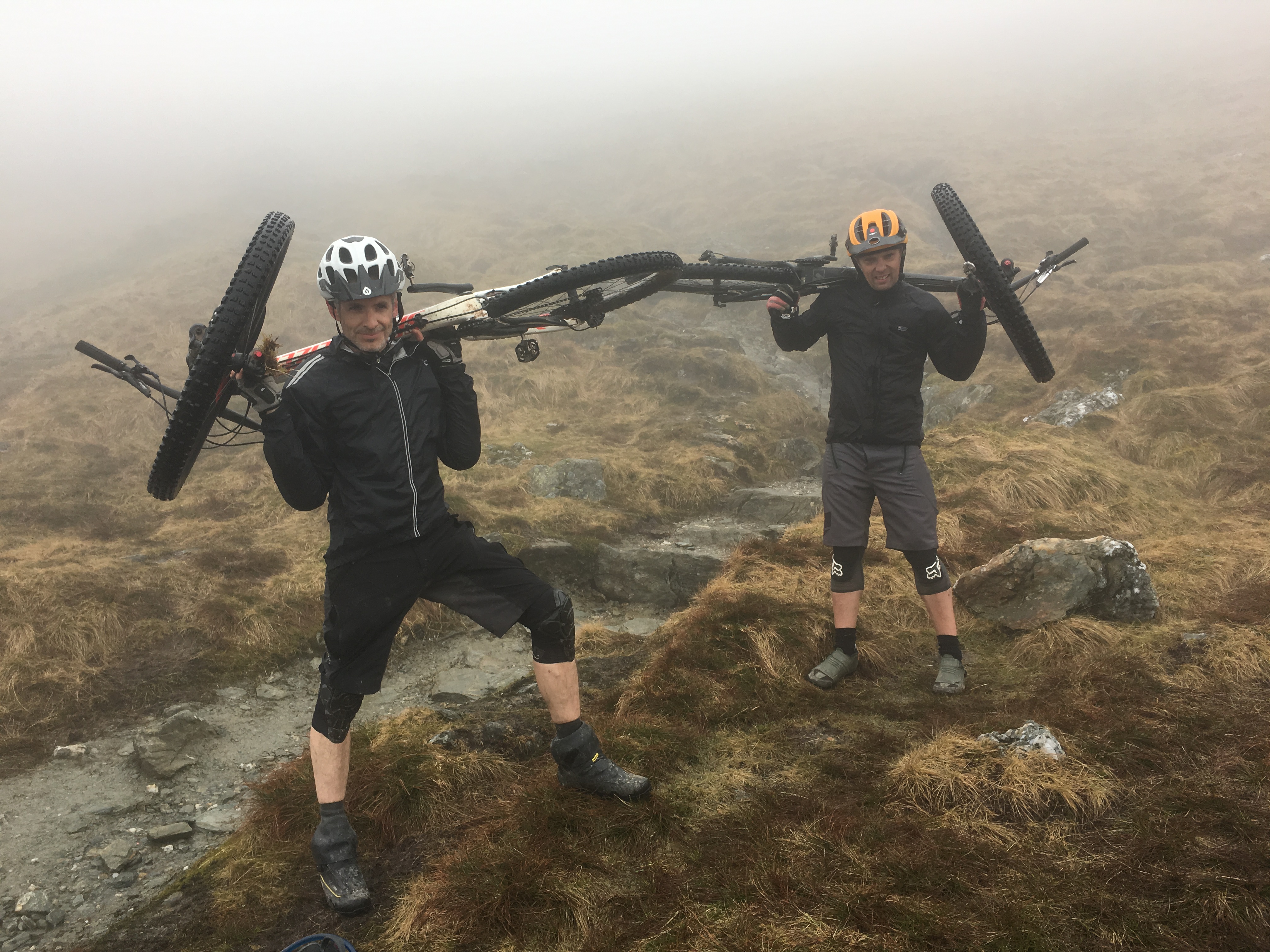
We had been in cloud for the last hour and the wind was gusting hard enough to push us over. Jim was getting seriously cold without any winter gear so we gave up on the summit attempt and started our descent. It started so well, amazing raw trails down bare rock with tight corners. However the rocks were so jagged we had 5 punctures in the first 200 metres.
Only Mariusz’s bushcraft mechanic skills saved the day – cutting patches with a sharp stone and filling holes with rubber band knots.
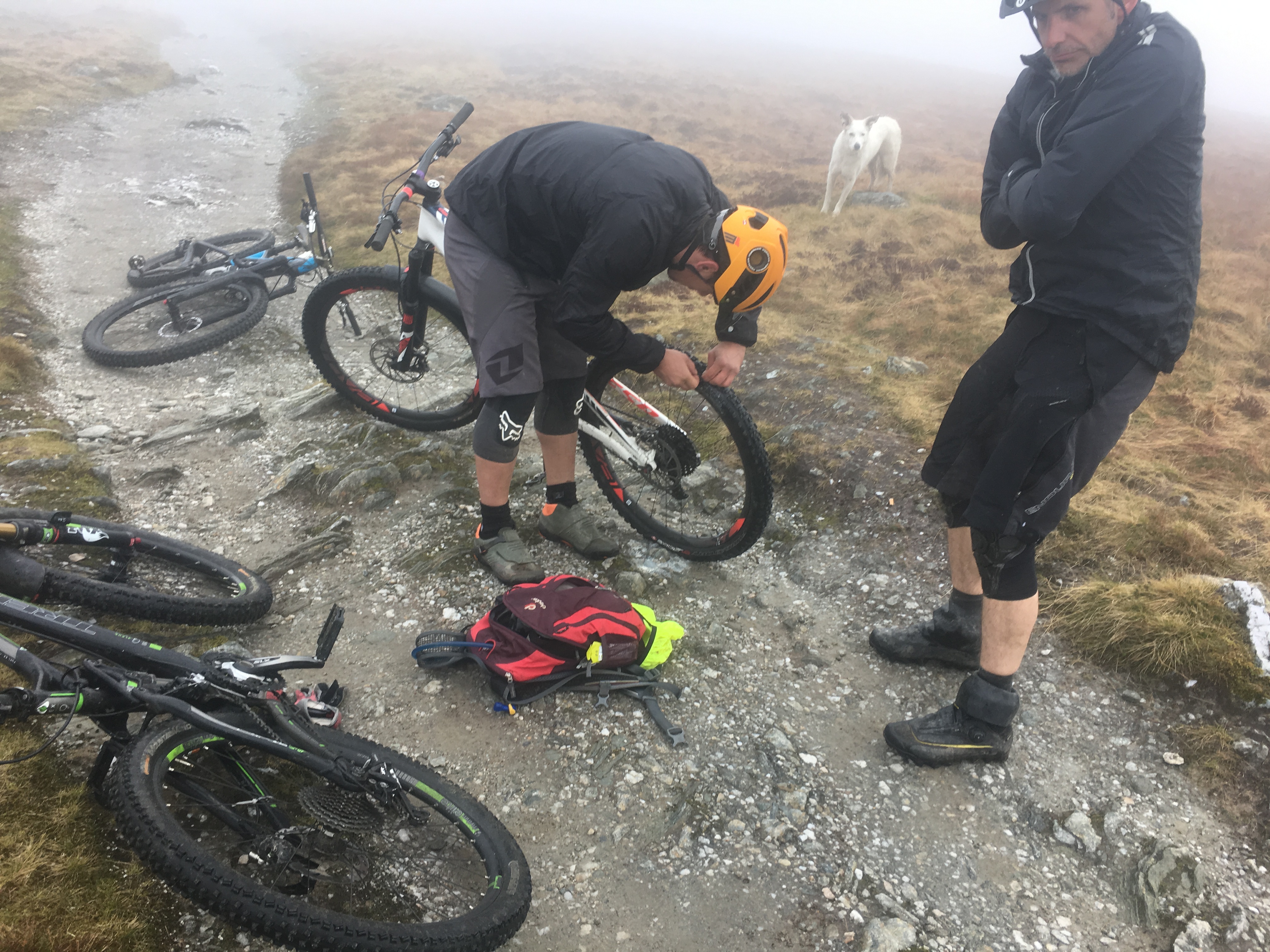
Soon the spare tubes and patches run out and Tom ended up pushing his bike back down the mountain, the views made it more bearable!

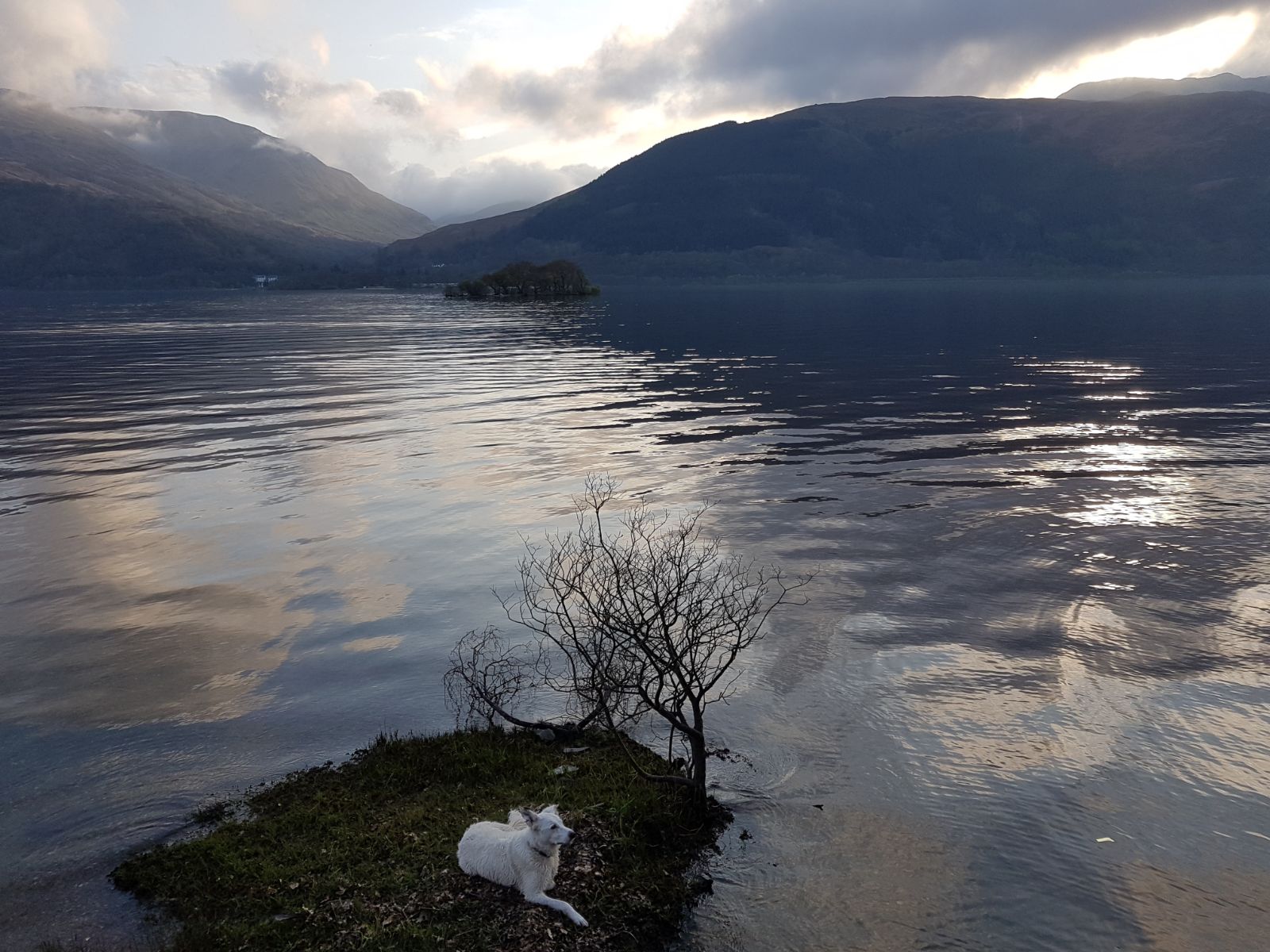
We were exhausted, frustrated and hungry when we got back to the van so headed straight to the Clansman pub on the lake side. We devoured pints of real beer, bean burgers and bloody mary style mussels, while both hen and stag groups arriving by boat on their pub crawl around the huge loch. We returned to the campervan parked on a stunning beach.
Sunday
On our last day we were heading North to Fort William – the mecca of Downhill biking in the UK. We made an early start and it took an hour just to drive the perimeter of the loch. From there were in the highlands passing epic wilderness around Glen Coe.

Again we had left the sun behind us in the South, as it was cloudy with drizzle when we arrived at the bike centre at the foot of the Ben Nevis range. Got got ourselves ready and bought an all day lift pass for the gondalo from the car park to the peaks. Everything was new to me and super exciting. From the gondola we watched riders below us hitting huge jumps on the ‘motorway’ section of the world cup down hill track. As we climbed the mountain we suddenly broke through the cloud to an incredible sunny summit with snow still in deep drifts around us.
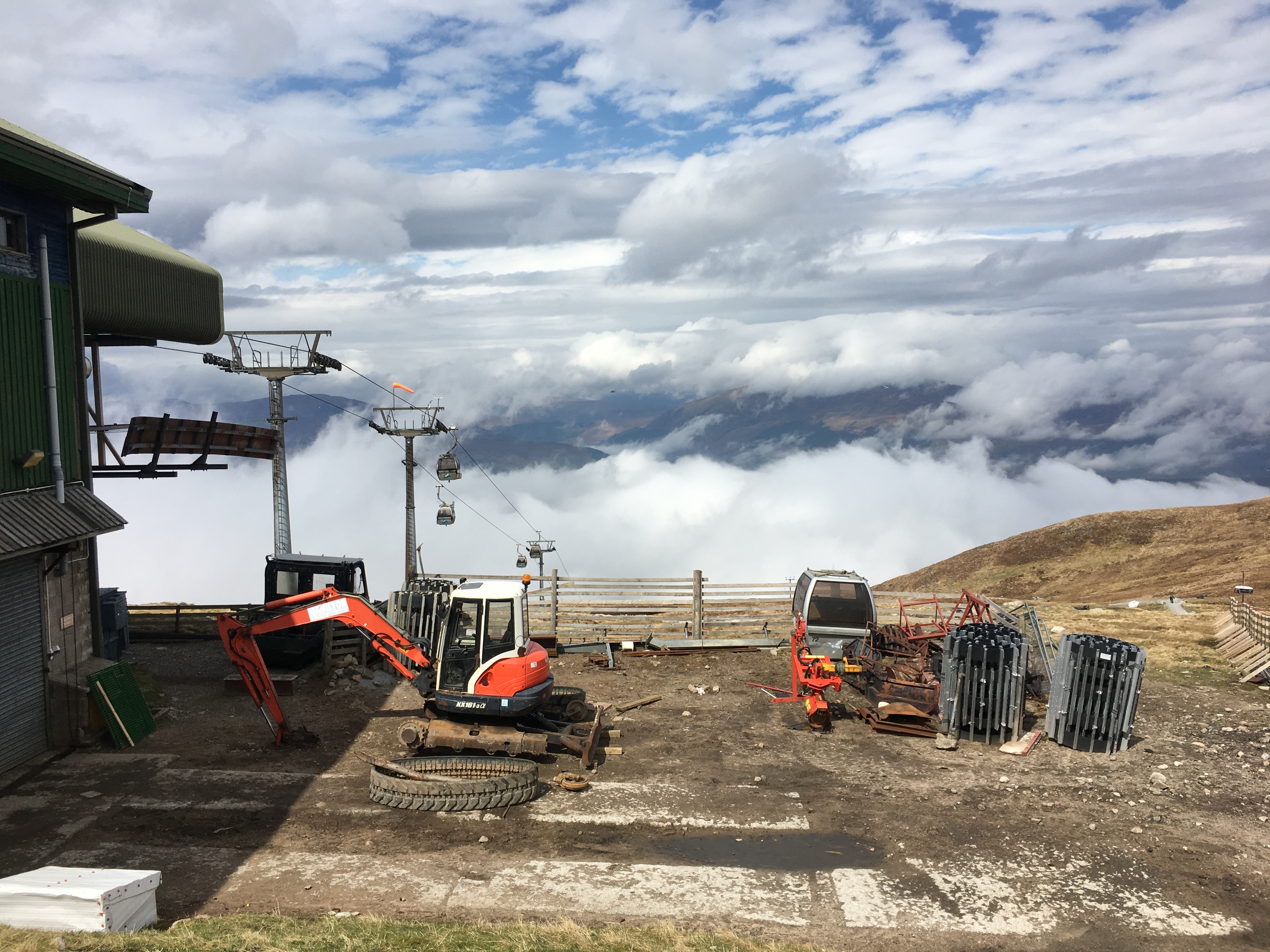
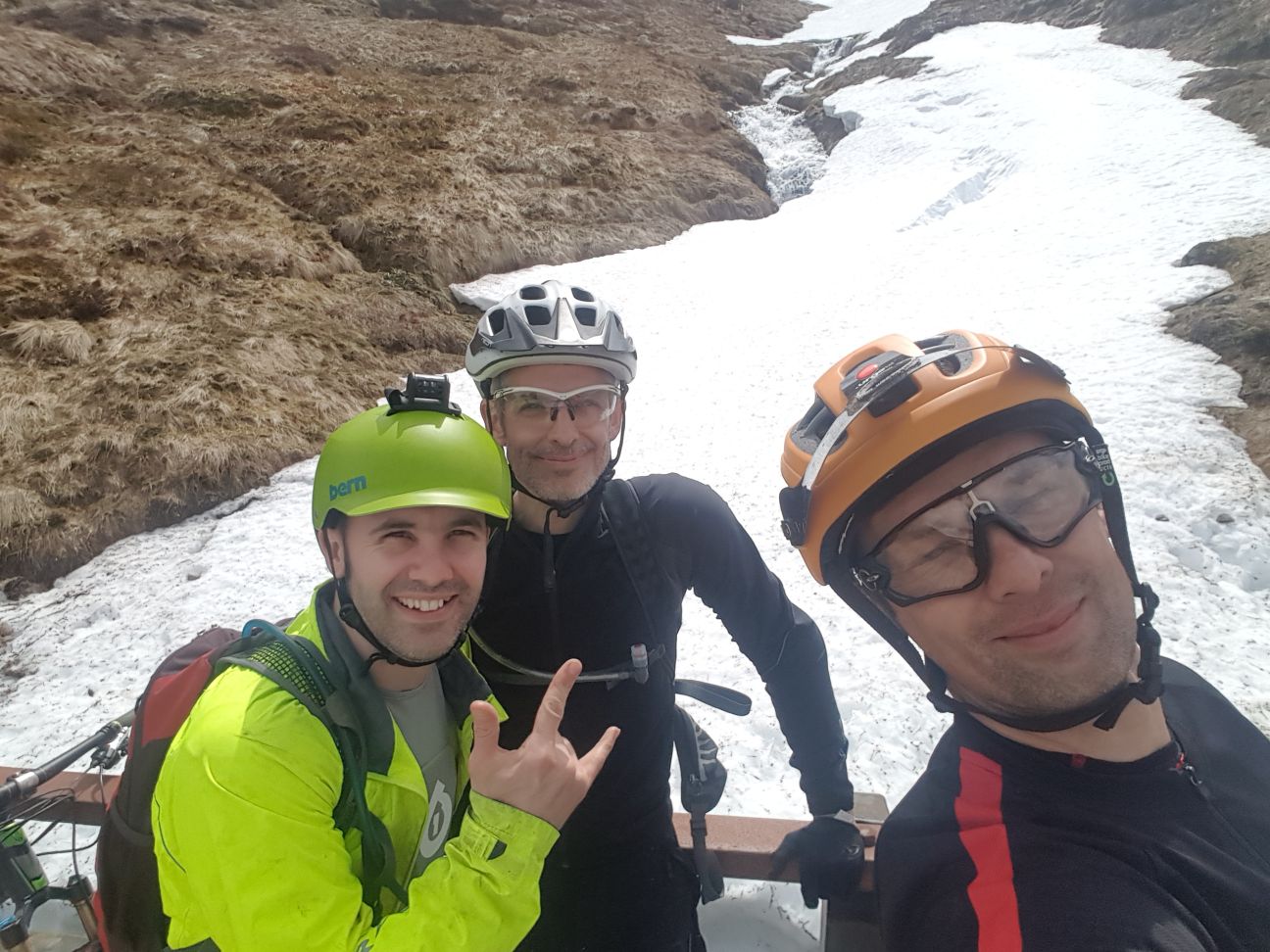
I had serious butterflies as we started our descent on the less extreme ‘black’ downhill run which I muddled my way down without incident taking in the fab views.

We got back on the uplift for our second run and Jim had two nasty tumbles. On our way down we found a ‘beginners’ orange downhill run with little jumps and drops to hop over.
Mariusz strapped my GoPro to his chest for our third and final run – which was epic as we knew the course and had some flow (bike confidence).
My confidence grew hugely – allowing me to trust the long travel of the bike to get me down 95% of the track with only one serious tumble.
It was easily the best day of riding I’ve ever had
It was amazing to see so many other riders of all abilities, size, age and gender and be in a place with such heritage. A few weeks later the Olympics of downhill racing (World Cup) was at the course, and I watched it live on Red Bull TV imagining how intense the atmosphere must be. Finally we called it a day and headed to Glen Nevis campsite with unreal views all around us.
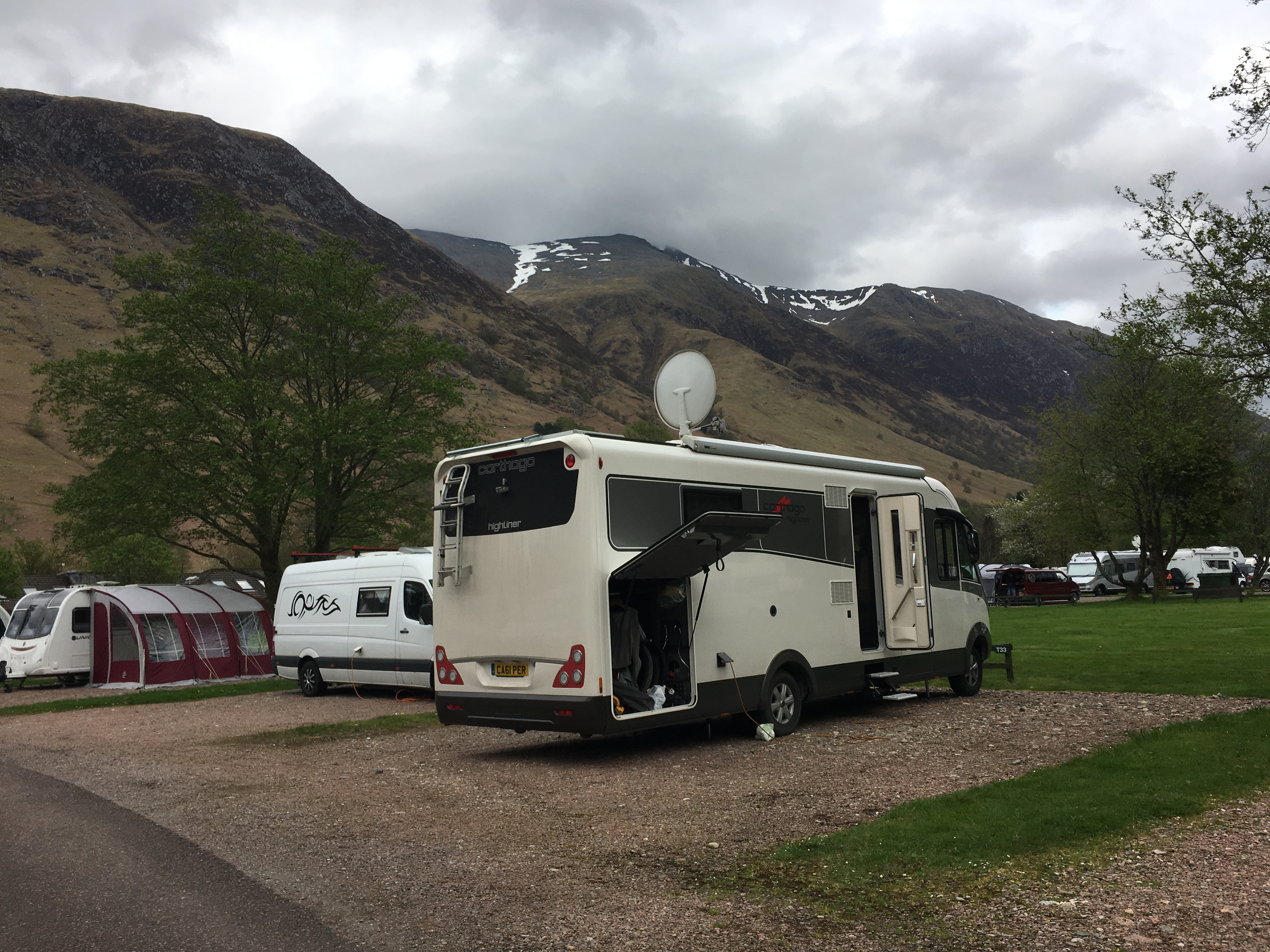
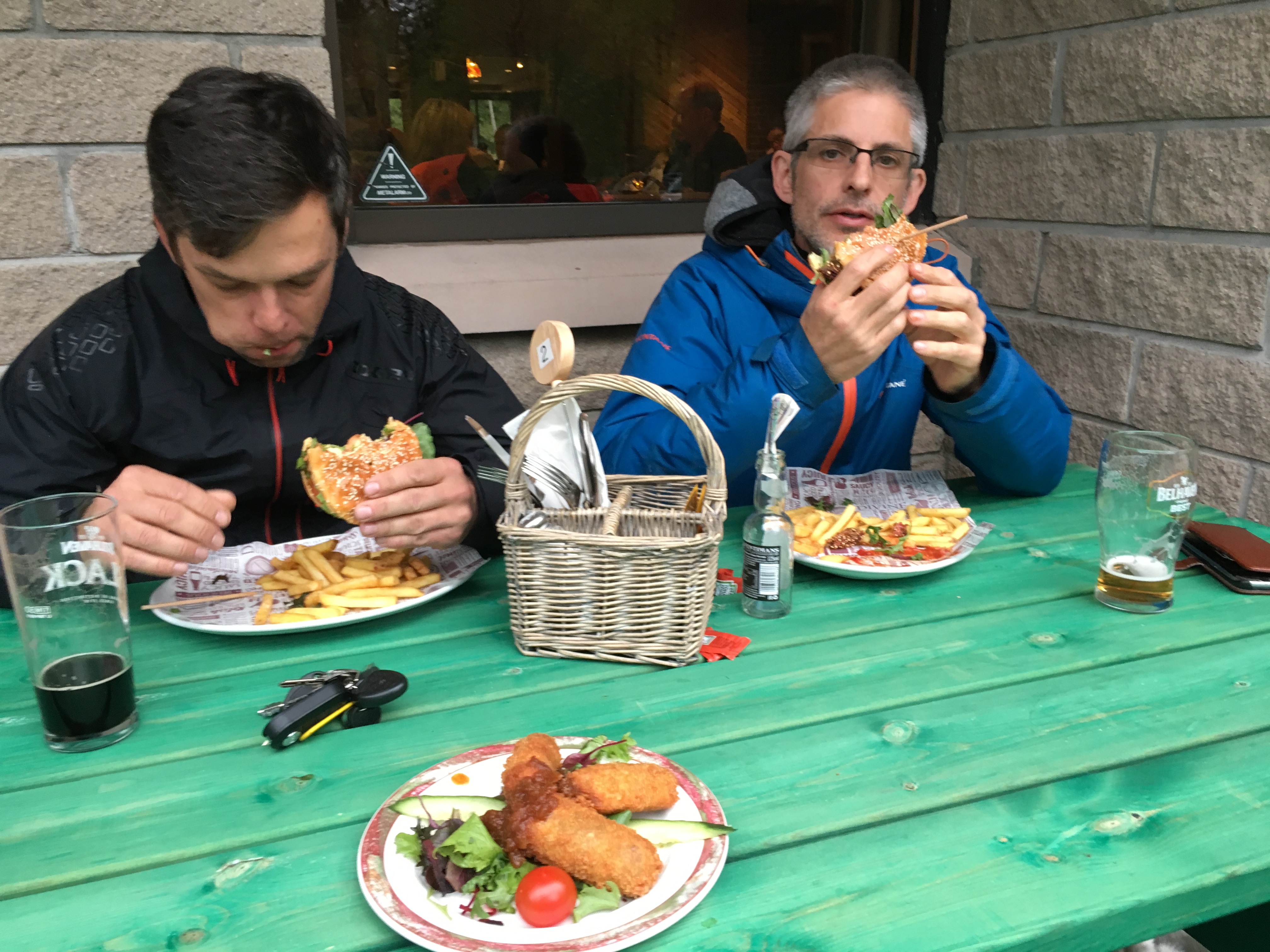
We spent our last night in the excellent campsite pub enjoying battered Hagis croquettes and pints of local ale before going back to van to watch the surprisingly good go pro footage from our day. Jim was very sore and we were all tired, but elated.
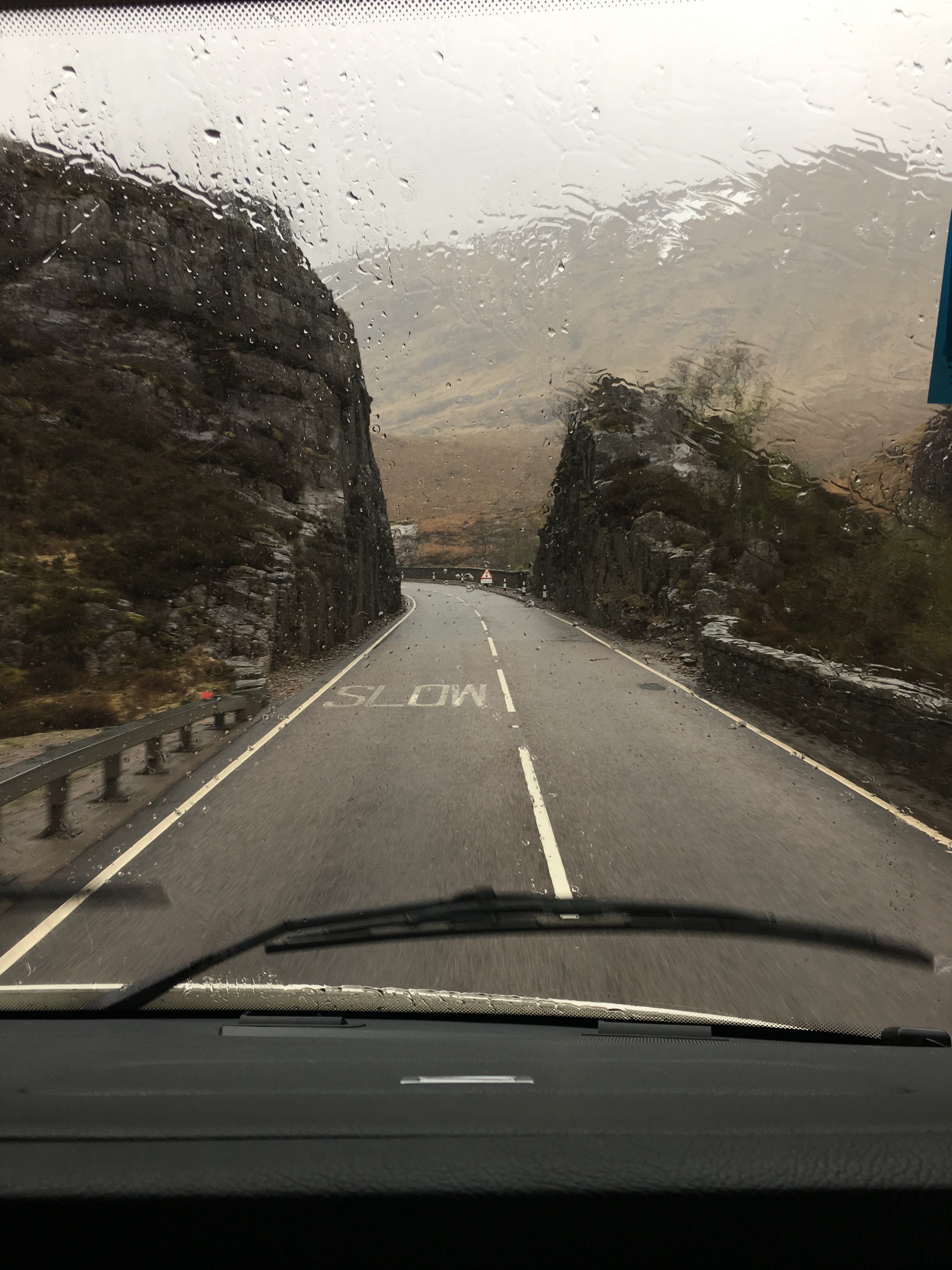
All that was left was an 8 hour drive back home on Monday through more typical Scottish weather, returning to the flat and tame reality of the south.
Blockchain and Bitcoin Blues
Posted on March 15, 2018 Leave a Comment
[This is an archived blog item written in March 2018, when I was working at 44 Communications.]
Following a few bits of bad press for technology, Tom Ives, 44’s Head of Innovation and Insight, takes a look at a few new tools coming down the line and bringing a more positive future with them.
I’m sure you will have heard about two of the latest scandals to rock the world of tech recently. First came the Facebook data scandal where a confusing four-year-old data breach that affected 50 million individuals resulted in political campaign specialist Cambridge Analytica suspending their CEO Alex Nix.
One company got the data legitimately from users of a Facebook app, but then broke the rules by passing it to third parties, one of which being Cambridge Analytica. These third parties then allegedly used the data as intelligence for targeting the most susceptible audiences for the fake news surrounding the Trump election. This has also raised questions about the Brexit vote too.
This was bad press for progress, as it showed that technology originally envisioned to bring communities together can be manipulated to drive them apart.
Secondly, came the story of a tragic fatality when a pedestrian was hit by a self-driving car in Arizona. It’s too early to know exactly why it happened, but it’s clearly a watershed moment for a utopian idea.
Take back control
The #deletefacebook campaign is a predictable knee jerk reaction to the scandal – to abandon the site in protest. But tempting as it seems to me, I can’t leave the ad network where I do 90% of my socialising with family and friends. And it is an ad network – the service is free because our data is the product Facebook make money from. As the data breach proves, we – ‘the products’ – are truly valuable. Companies can use our data for their own gain, if they can access it. The popularity of the hashtag is a sign that the public want to take ownership of how their information is used and want to know what’s happening.
To realise we are treating this new technology like cigarettes in the 60s; chain smoking because adverts tell us it’s good for us.
People need and want to take back control. If we are ‘the product’ then we should get to make some of the calls. It is possible to manipulate technology to… , but there is always another incoming wave that can solve the problems in the last iteration. Whether you believe innovation comes from the rainforest effect of mass competition and diversity, or that necessity is the mother of invention, dissatisfaction with the status quo drives opportunity for promising alternatives. One of these upcoming opportunities is the blockchain.
Blockchain
Even if you haven’t heard of blockchain, you may well have heard of bitcoin – the cryptocurrency that runs on it. The simplest explanation of the blockchain is a record of something shared over so many computers connected to the internet that it can’t be maliciously changed or hacked, as the difference would instantly stand out from the other million. Bitcoin is a new kind currency that uses the blockchain as a record of transactions (and so doesn’t need banks or international financial rules).
But bitcoin has a lot of hype surrounding it, and its own share of bad press. Blockchain on the other hand could be a technology to fuel a more hopeful future. One of many imagined applications is the end of passwords (weak or strong), as the blockchain will be able to verify your real identity, because it knows your history. Another use is a decentralised store of any important data – meaning central servers can’t be hacked for the data, as it’s not all kept in the same place.
Another way
Inventor of the world wide web Sir Tim Berners-Lee has begun a new project called Solid. Solid imagines a world where you would keep your private data like money in the bank, and allow social networks (or any business) to access it how and when you wished them to. If you were unhappy with the service, you’d withdraw your money (data). The social networks wouldn’t be able to sell this data on, or be hacked or breached – as they wouldn’t hold it centrally anymore.
This would change the business model of some of the biggest companies in the world (not just the internet) Google, Facebook, Amazon and Apple. They have grown so fast because they scale their profit on our addiction to convenience, and what this data tells them about what we’ll buy for Christmas. The blockchain, Solid or another bit of tech yet to be invented could create a new version of LinkedIn where we take our connections, experience and merit from one employer to another – owning our own career credit as we go.
Lost Memories
Posted on January 15, 2018 Leave a Comment
[This is an archived blog item written in January 2018, when I was working at 44 Communications.]
Our Innovation Manager Tom Ives lost his online memories, which made him worry about the cost of the convenience Facebook and Google provide us with. He concludes on what we can do about it.
When I was a student I used an innovative social network for clubbers called ‘dont stay in’. It was a great place to post pictures of your big night out – tagging your friends and keeping those good memories online. This was before Facebook existed.
I made friends via the site, I connected with DJs I liked, and later I used the website to promote the gigs I ran with my friends to other clubbers who were into the music. Dontstayin.com was both location and genre segmented – creating concentrated communities of like minded people. Good times with friends and first encounters with future partners were captured on the site, a narrative across my four years at university in Birmingham.
12 years on, I remembered it and hit the URL to take a trip down memory lane.
It was gone – the business had been sold, a new site replacing it. I had no other archive – all my pics and memories were gone. I was gutted.
Not long afterwards I needed to find the date when I went on holiday eight years ago. I went straight to Facebook, found the pics of me on the beach and looked at the date I posted. I haven’t used Facebook much in the last two years certainly not to post – I took the app off my phone. Amidst my newsfeed of nonsense one of the few things I still like is when timehop reminds me what happened six, eight or ten years ago.
Like my search for holiday pics it transports me back to a diary I made of how I felt, where I went, what I ate and who I talked to. And it fascinates me – I’ve forgotten the fine detail but I’ve also forgotten why I felt so comfortable to broadcast the trivia of my life on Facebook. I’m very reticent to do so in 2018. I kept my distant friends and family in touch with my first daughters every goofy grin, but I want my second daughter to have some privacy – for her early years to not be in Facebook’s ad targeting database. Consequently my network barely see her progress through crawling, walking and learning to talk. In five years time I wont have much to look back on 2018 and reminisce. And that’s really sad.
What is more sad and shocking was my realisation that like Dontstayin.com at some point Facebook too will go away, or at least it’s free and unlimited catalogue of memories I enjoy.
What can we do?
When I heard the quote ‘if the service is free, you are the product’ it instantly made sense of these troubling feelings I have. Google Mail, Facebook Linked In and others are so wonderfully convenient and ubiquitous that we take them utterly for granted – not recognising how expensive and complex they are for their businesses to provide to us. And we are hooked – not just by our laziness, but by the real life connections that are enabled through the medium.
So what can we do? Is it too late to try and take back our memories – or just too hard work? I had a look around and realised my Amazon Prime account has unlimited photo storage. OK I’m equally uneasy with how Amazon indexes my family life in order to recognise our faces. But at least I’m paying for the service – as a customer can I expect my files persist a bit longer? And my pics aren’t in the public eye anymore. Apple’s iCloud is great value for storage and the ecosystem across my phone, tablet and computer is silky smooth. But I don’t want to be locked into the Apple ecosystem anymore than I already am. I’m not even going to look into running an email client on a server I run and pay for myself.
My personal favourite solution is wonderfully analogue. The creation of a photo book of just the very best holiday memories, along with the most sentimental captions has been surprisingly enjoyable and I guarantee it’ll persist on my book shelf.
Me @ Work
Posted on November 15, 2017 Leave a Comment
[This is an archived blog item written in November 2017, when I was working at 44 Communications.]
The annual IOIC Insight Seminar this week was themed around employee voice, and how employers benefit from becoming a listening organisation. The seminar was opened by Cathy Brown, fittingly as employee voice is one of the four enablers identified by engage 4 success.
She posed that ‘Organisational behaviour / culture is simply an aggregation of individual behaviour / culture.’ It sparked a lot of thoughts on the night, and with me. My first reaction, if I’m honest is that I don’t agree.
I believe a few individuals (usually the founders or owners) set a culture and then people click with this or not. In a corporation there is simply too much variety for a culture to be so granular – yes there are common things they recognise, but they must match / rationalise their personal point of view with the company, make a compromise and fit in…. right?
There’s been a lot of talk about why we change when we get to work, how we are perceived and act differently. Some think we should be our authentic selves at work, because only then can be our best selves. If that’s true then we have a problem as a Deloitte research study (Uncovering Talent) found less than half of us do.
As a sales person or anyone in delivery, you have to be more direct than you would outside of work (sometimes it could be considered rude.) You have to be unemotional, logical and objective. If you empathised overly with everyone else’s challenges you wouldn’t be delivering on your objectives. Tell me I’m wrong.
I’ve struggled with bosses, colleagues, clients and suppliers who switch between this directness and a very pally, friendly behaviour. I’ve found the inconsistent behaviour disorientating, and I get on better with people who are more of one or the other, most of the time.
Work relationships are odd. Of course as social animals we need them, we spend so much time with colleagues it would be uncomfortable not to. They are often great fun as you are thrown together arbitrarily. Your common bond is the workplace, so you go out drinking as work mates, enjoying the cross section of society – the forced cocktail of nerds, rockers, golfers and gamers (or whatever your mix).
I guess I feel it’s not just work. Me @ work is different to Me @ home.
Me @ home posts pics of family times onto a family only WhatsApp group. Me @ holiday posts sunsets to Facebook (but not much else). Me on a night out with old buddies posts a lot more laddy banter on FB messenger. Me @ bike posts my average speed and suffer score onto Strava. And me at the hipster coffee shop posts enhanced photos onto Instagram.
Maybe it’s just me – According to the many personality tests, I’m the kind of person who likes to keep different parts of my life in different boxes, to have clear lines of separation.
For decades the internet has given us the ability to have a separate online identity. Social psychologist Alex Krotoski is an expert in this field. In her book Untangling the web she concludes from many research studies and countless interviews for her radio and podcast series the digital human that amazing things are possible when anonymity allows someone to be someone else. We can try new things without being judged, let go our secrets and guilt, find communities that share our passions, enjoy the fantasy of playing a role (like in a computer game.) Obviously trolls are out there too, not all our alter egos are heros.
In October I attended a very slick sales presentation at Facebook of their workplace product. A stand out claim was that for current graduates at FB onboarding included training on what email is and how to use it. This could be a well pitched sales technique for corporates who are ready to believe millenialls are another species, however the claim came back to me at the Insight Seminar. Cathy Brown said we have all got used to being asked for our opinion, to rate, review and feedback every customer experience we have. We expect to be listened to and action taken.
Digital natives that have grown up with this social / online world are going to take this for granted. Facebook explained that the ability of employees to choose their channels and groups meant they could essentially ‘unsubscribe’ from all company announcements. ‘It’ll force your comms to be more engaging’ they told us. Facebook is great at listening to data and personalising content too, so even if they don’t unfollow you, if they aren’t engaging with the content then the algorithm will show it less in their news feed.
A peer to peer / bottom up social network more like chat than email will naturally be all about employee voice – on numbers alone top down company comms is going to be the minority. But the reactions, conversations that spread virally will be huge – and that’s what will reach people. User generated content always stands out as raw and sincere. It hasn’t been carefully crafted and edited – the authenticity is evident. The reader has taken action so are more likely to be on a subject they are passionate about, or at least engaged with in the moment. No internal comms could possibly achieve this – nor should they try. The future role of facilitator not message owner was made several times in the seminar. So I can see a technological democratisation being key to moving to a conversation with the employee voice.
A communications challenge? Game on.
Posted on October 15, 2017 Leave a Comment
[This is an archived blog item written in October 2017, when I was working at 44 Communications.]
Games aren’t just something nerds play in dark rooms, or families squabble over at Christmas. 44’s Tom Ives explains why embracing games can help you top the comms leaderboard.
The best communications are tailored to their audiences so they make a lasting impression.
By taking into account how humans behave and what our decisions are based on, you can create a great, tailored experience and produce a successful product or service – whether that’s a mobile fitness app or an internal newsletter. And what better way to get them engaged in your offer than through games?
Loading…
Think about it. People use games as a way to learn and enjoy themselves – they’re fun, absorbing, challenging, educational and at times even addictive.
If you’re not convinced about the potential they have, consider when China’s Wing Gaming won The International 2016 eSports final in Seattle. Not only did they earn $9.1 million, but they drew thousands of fans to the arena to watch a video game.
The value of games has also been recognised by the medical profession, with the game Neuroracer. This medical experiment uses experiences, instead of drugs, to treat people with cognitive issues. By measuring players’ brain activity through an ECG cap as they play, it’s been proven that people aged 50+ could increase their working memory and sustained attention to the same level as a 20 year old over a few months.
Another great non-traditional use for gaming is reMission – a game created for children undertaking chemotherapy for leukaemia. The game allows them to fight off cancer virtually inside a body as a mini-superhero. Scientists observed increased joy, optimism and confidence levels in the players, which activated the brain circuits involved with motivation – the same parts of the brain associated with patients’ increased adherence to treatments.
Following clinical trials, reMission has helped more than 135,000 patients stick with their cancer treatments and gain a greater sense of personal empowerment and control over their disease.
Inspired yet?
Gamification is where typical elements of game playing – point scoring, competition with others, rules of play – are applied to other activities like marketing or communications to encourage engagement.
If you need to move up a level with your communications, here are three ideas:
1. Living the dream
When asked for ideas to raise awareness of a client’s business strategy, we suggested a game that put the players in the shoes of the organisation’s leader.
Like SimCity or Farmville, the employee has to find the perfect format for the ever-changing needs of customers within different locations, budget constraints, a competitive market and challenge supply chains. The result? Serious, complex process messages made simple.
2. Friendly competition
A great example we’ve seen in the industry is Albert – the learning and development game Virgin Media retail uses for its staff. Played on in-store iPads or employees’ personal Android and iOS devices, Albert keeps 1,200 sales execs in the know. Users complete three daily challenges about their roles and the business, receiving ‘experience points’ every time they play and boosting their personal scores every time they answer correctly. An employee leaderboard shows who knows their stuff.
3. Points mean prizes
Nudge is an app to reward employee behaviour. Frontline staff use Nudge on their personal devices to receive commercial updates and information, like daily offers and product news to help customer service. Employees who read the updates get a few points and those who act on it (upselling or pushing offers) are rewarded with more. This is a way to encourage engagement by turning points into actual rewards – money, benefits or products.
Hopefully you’ve now got your head in the game. And we’ll give you 44 points if you gamify your next communications project…
The new New Media
Posted on September 15, 2017 Leave a Comment
[This is an archived blog item written in September 2017, when I was working at 44 Communications.]
New Media is defined as websites, mobile apps and interactive computer games. But as the first website was made in 1990, the iPhone has just turned ten years old, and the video game industry is twice as profitable as Hollywood these industries are no longer ahead of the curve – but the curve itself.
44’s resident innovator Tom Ives takes a look at how the new New Media of Augmented Reality, Mixed Reality and Virtual Reality will change the workplace of the future.
If you’ve been reading the tech headlines this week, or were simply not under a rock, you will have noticed that Apple have unveiled their new iPhone line-up. Controversial new designs aside, they listed various new technologies that were not only capable using the new device – but native to it.
We’re talking specifically about Augmented Reality; the mixture of real and digital content viewed through the device. Players of Pokémon Go will know what this feels like, along with the frustration of missing out on that Snorlax. Augmented Reality is going to be big business, and Apple has made it clear this week that their technology will handle the vast graphics and processing power required to make Augmented Reality, a reality.
Since Apple unveiled their ‘AR Kit’ in 2016, developers have been using it to create some amazing apps like this car visualiser
The phone’s native sensors are used in AR Kit – for example the amount and direction of light means the shadows on the virtual object make it seem more real.
Google are next to market with ‘ARCore’ their equivalent toolkit, five years after their launch of the ill-fated Google Glass product. Facebook are experimenting with 360 video, an immersive experience which businesses have been using to showcase holiday destinations and hotel lobbies.
These are all great new developments, and if you’re wondering how this will affect your business and your people there are two things to consider about the future of mixed reality. What it can do, and what it will do.
What Augmented Reality can do…
Arguably the most interesting Augmented Reality product (aside from trying to catch a Pikachu in your back garden) is Microsoft’s HoloLens. Early adoption of the pricy tool by businesses will mean it’ll soon be available to consumers too. The HoloLens is leading the pack because it doesn’t replace the real world with a virtual world (as does the entire-enclosed HTC Vive or Oculus Rift headsets). The HoloLens’s headset is transparent and enables you to see information in the digital world alongside information in real world – by overlaying both together.
For example: If you are building a house, you can walk around the actual foundations and overlay the accurate architectural drawings on top using the HoloLens. If in the digital world you see that the walls are three feet longer than the real, physical concrete foundations, you’ve got some changes to make.
The applications are endless, and HoloLens might even replace your desk. Take all those screens, notes, books, calendars and replace them with digital editions. You can take your desk with you. You might need it on the beach.
What Augmented Reality will do…
The flipside to all the technology is, of course, the human element. If you’re in a meeting and you see somebody start to look at their phone – you might consider it rude. Give them a headset where they are not only looking at you, but also checking your Facebook page, your LinkedIn profile and looking at your latest tweets – it’s not just rude anymore, but actually invasive.
This invasiveness is, in part, one of the reasons people rejected Google Glass. On a human level people don’t like being watched, or studied, or measured. When Augmented Reality becomes ever present, it will become harder to know if somebody is looking at you or their screen.
Another headset manufacturer ‘Meta’ approach augmented reality from the neuroscience angle. They are researching (and patenting) the cultural and social effects of the new technology.
Meta’s CEO Meron Gribetz explains this in a podcast with science fiction writer Rob Reid. In the interview he explores this new paradigm shift where centuries-old (2D) media will be replaced with new (3D) digital possibilities. The solution to the invasive nature of Google glass is ‘public by default’. This means what one person can see in their AR headset, others can too- meaning social norms inhibit rude behaviour. It’s well worth a listen and you can find it on the author’s website.
We know that the new New Media will be a mix of the real and the virtual. We know that it will change how we work, where we work and will create new and exciting industries. What we don’t know is how mixed reality will affect our behaviour, how we treat each other and act around each other. We don’t know, because this is for us to decide. The reality we choose to create.
The power of listening
Posted on August 15, 2017 Leave a Comment
[This is an archived blog item written in August 2017, when I was working at 44 Communications.]
As a creative agency we put a lot of effort into crafting visuals to complement the words on a page. But what happens when you strip all of that away and just focus in on a voice? 44’s Tom Ives takes a look into the world of podcasts and how using only your ears can open up whole new worlds.
I love podcasts. They’re such an intimate way of communicating – it’s just the listener and the voice.
Podcasting first became popular in 2005 and got a dedicated iTunes app in 2012. Since then it’s developed a large following with podcasts for nearly every topic, offering a whole host of new presenters and voices – and the freedom to take them with you wherever you go.
They’re also, usually, very honest. A lot of presenters start doing podcasts as personal passion projects rather than as commercial ventures. They’re accessible to anyone and there’s endless choice – which means I can access tonnes of the good stuff I like to nerd out on.
With the absence of any visual stimulus, content is king. The chemistry between the interviewee and the interviewer, and how that is translated to the audience, is more important than ever.
Here are three of my favourite current podcasts and what they’ve taught me about keeping content engaging…
Modern Mann
Olly Mann interviews a range of interesting people and has hard-hitting conversations with them. In one episode he spoke to a real-life cyber hacker who has now become a law abiding, business-owning ethical hacker. The unnamed hacker explains that a childhood of abuse left him with severe trust issues. This sent him looking for ways to attack other people and to avoid being attacked himself. Computers gave him a weapon to do this with – and he…
Lesson 1: Don’t judge a book by its cover. If you looked at this now-ethical hacker at work, you wouldn’t know about the difficult journey that led him to this career – this extra information gives his story new depths.
Daily Tech News Show
American tech journalist Tom Merritt streams a new, hour-long podcast every day of the working week. And if you’re thinking there’s no way it can all be quality content you would be wrong. Tom has a new co-host each day to help him, from different backgrounds including art, media, PR, politics, gaming, security and other related fields.
Lesson 2: You can find inspiration for content anywhere. But if you need extra ideas, get someone else on board! Tom keeps his shows varied with different topics, but also by bringing in the new perspectives of guests from different fields. Don’t limit yourself by sticking to what you know – bring in outside experts to widen your perspective.
Song Exploder
This podcast is an incredible insight into how music is actually made. Through in-depth interviews with bands, Hrishikesh Hirway exposes their personal stories of inspiration and ideas, and also the techniques of production that make a song so powerful and memorable. They’re all good in my eyes, but if you were only going to listen to one, I’d recommend MGMT’s time to forget.
Lesson 3: It’s not all about the final product. We’ve all got our favourite songs, but the process and stories behind them can be just as engaging and inspiring. They might not come with a catchy chorus, but there’s a lot you can learn from stories of how things are created.
 Tom Ives